From Governance Runtime Assurance to Human-Directed Intelligence
Working note from BPM RED Academy / HumAI MightHub development
In my previous posts, I explored the progression from deterministic inference toward governance runtime assurance for regulated and mission-critical AI systems.
The core direction was simple:
AI for high-responsibility environments cannot remain a free-form generative layer.
It must become measurable, constrained, auditable, replayable, and governed.
That development path introduced several control-plane concepts:
- deterministic execution paths
- mission-aware routing
- fleet consensus scoring
- route reliability tracking
- governance runtime metrics
- audit-ready decision traces
- human review gates
Those layers improve trust.
But they also raise a higher-order question:
What actually controls the AI system?

1. The control surface question
Most AI systems are still discussed through model-centric properties:
- model size
- latency
- throughput
- token efficiency
- accuracy
- context length
- agentic capability
These remain important.
But in regulated, institutional, defense, financial, healthcare, and mission-critical environments, the more important question is different:
What is the mission, what are the constraints, which standards apply, what is the acceptable risk boundary, and who remains accountable for the final decision?
This shifts the control surface of the system.
The model is no longer the center.
The mission is.
2. From model-centric AI to human-directed intelligence
A model-centric AI system asks:
What can the model generate?
A governance-native AI system asks:
Can the output be trusted, audited, constrained, reviewed, and aligned with institutional responsibility?
A human-directed intelligence system asks an even higher-order question:
Can human intent be translated into a measurable, policy-aware, standards-aligned, confidential, and reviewable execution path?
This introduces a layer above governance runtime assurance:
Intent Assurance
3. AI Control Surface Hierarchy
The proposed hierarchy can be represented as:
┌────────────────────────────────────────────┐
│ HUMAN INTENT                               │
│ Mission • Objectives • Desired Outcome     │
└─────────────────────┬──────────────────────┘
                      ↓
┌────────────────────────────────────────────┐
│ POLICY & CONSTRAINTS                       │
│ Law • Doctrine • Risk • Boundaries         │
└─────────────────────┬──────────────────────┘
                      ↓
┌────────────────────────────────────────────┐
│ GOVERNANCE RUNTIME                         │
│ Routing • Scoring • Reliability • Review   │
└─────────────────────┬──────────────────────┘
                      ↓
┌────────────────────────────────────────────┐
│ CONFIDENTIAL EXECUTION                     │
│ Protected Context • Secure Processing      │
└─────────────────────┬──────────────────────┘
                      ↓
┌────────────────────────────────────────────┐
│ MODEL FLEET                                │
│ NIM • Triton • LLMs • Runtime Paths        │
└─────────────────────┬──────────────────────┘
                      ↓
┌────────────────────────────────────────────┐
│ CONTROLLED ADVISORY OUTPUT                 │
│ Recommendations • Options • Risk Signals   │
└─────────────────────┬──────────────────────┘
                      ↓
┌────────────────────────────────────────────┐
│ HUMAN AUTHORITY                            │
│ Review • Approval • Rejection • Override   │
└────────────────────────────────────────────┘
Cross-cutting layer:

AUDIT • TRACEABILITY • REPLAY • ACCOUNTABILITY
The important point is that the model is not removed from the system.
It is placed inside a governed execution hierarchy.
The model remains powerful, but it is no longer the highest authority in the architecture.
Human intent becomes the primary control surface.

4. Intent Assurance as a measurable layer
If governance runtime assurance measures whether the execution path can be trusted, intent assurance measures whether the system remains aligned with the original human mission.
| Metric | Purpose |
|---|---|
| Intent Alignment Score | Measures whether the output remains aligned with the stated mission and objectives. |
| Constraint Preservation Score | Measures whether legal, policy, operational, and ethical constraints remain intact during execution. |
| Standards Mapping Score | Measures whether the system maps the process to relevant standards, norms, references, and doctrine. |
| Mission Drift Signal | Detects when the execution path begins to optimize for the wrong objective. |
| Human Authority Preservation | Measures whether final decision authority remains with an accountable human reviewer. |
| Audit Continuity Score | Measures whether the chain from intent to recommendation can be reconstructed. |
| Confidential Runtime Trust | Measures whether sensitive mission data and execution traces remain protected during processing. |
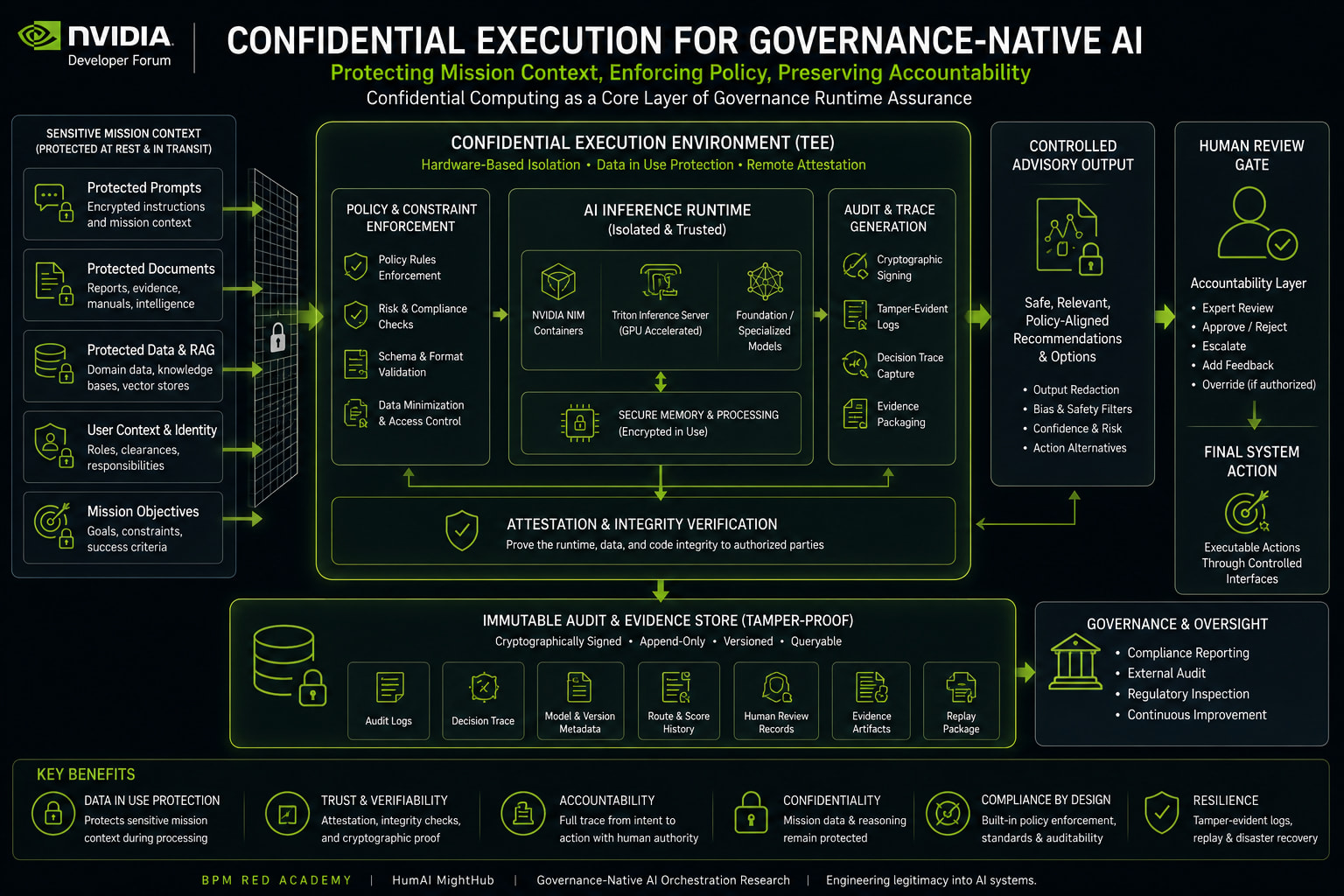
5. Why Confidential Computing matters
As AI systems move into higher-trust environments, the problem is not only inference speed or model performance.
The system must also protect:
- mission context
- sensitive prompts
- policy constraints
- documents and evidence
- route memory
- audit trails
- human-review decisions
- institutional reasoning patterns
This is where Confidential Computing becomes directly relevant.
For governance-native AI, trust is not only about what the model outputs.
Trust is also about where computation happens, how sensitive context is protected, how execution traces are preserved, and whether the system can be audited without unnecessarily exposing protected data.
In mission-critical AI, confidential execution is not only a security feature.
It becomes part of the governance architecture.
6. Technical parallel with accelerated infrastructure
As accelerated infrastructure becomes faster, raw inference overhead becomes less of the only bottleneck.
For regulated AI systems, a new layer becomes visible:
governance runtime overhead.
This includes the latency and reliability cost of:
- policy routing
- schema enforcement
- route scoring
- provider stability checks
- confidential execution
- audit evidence assembly
- human-on-the-loop review
- controlled advisory release
This is why I believe the next optimization frontier is not only faster inference.
It is also:
- more reliable orchestration
- measurable route trust
- audit-ready execution traces
- lower governance overhead
- confidential runtime assurance
- human-review-aware control planes
- persistent memory of execution behavior over time
7. Discussion question for the NVIDIA developer community
I would be interested in feedback from the NVIDIA developer community:
Should intent assurance become a first-class measurement layer for governance-native and mission-critical AI systems?
More specifically:
- How should human intent be represented inside AI control-plane architectures?
- Can mission drift be measured during runtime?
- Should confidential execution environments become part of governance runtime assurance?
- How should human-review gates be represented in AI orchestration telemetry?
- Can audit continuity become a benchmark for regulated AI systems?
- How should NIM, Triton, orchestration layers, and confidential computing environments support governance-aware execution paths?
8. Current working conclusion
My current working conclusion is:
The model is not the system.
The orchestration path becomes the system.
The audit path becomes trust.
The mission becomes the control surface.
Human intent becomes the highest-order input.
In this view, AI does not only need larger models or more agents.
It needs systems that can be measured, constrained, protected, reviewed, replayed, and trusted.
Edin Vučelj
Founder — BPM RED Academy
Creator of HumAI MightHub / FinC2E
Governance-Native AI Orchestration Research
Bosnia and Herzegovina
Engineering legitimacy into AI systems.