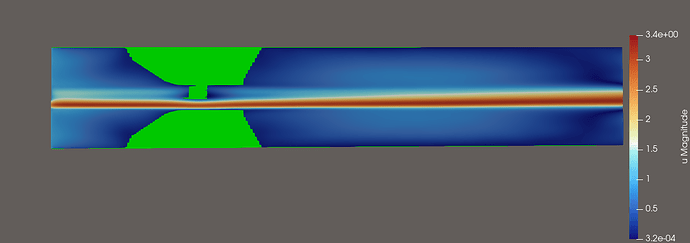
I’ve encountered some difficulties while using the PhysicsNeMo library. My project focuses on studying the flow field around a probe inside a wind tunnel. Initially, I followed the approach used in the aneurysm example and used Tessellation.from_stl to separately read the STL models of the wind tunnel and the probe. I then subtracted the two to obtain the fluid domain and the no-slip walls.
However, the training results have been consistently poor. The resulting flow velocity distribution, as shown in Figure 1, completely loses the expected physical behavior: instead of exhibiting acceleration in the contraction section, reaching maximum velocity near the thermocouple, and decelerating in the expansion section, the model instead produces a nearly uniform high-speed straight-line flow, almost laminar in nature.
Interestingly, if I only use Tessellation.from_stl on the wind tunnel model and keep all other settings unchanged, the model is able to learn the correct physical pattern quite well.
I would like to ask: is this a problem with my specific configuration, or is the approach of using Tessellation.from_stl for both geometries and then subtracting them fundamentally flawed? Should I instead follow the examples like FPGA and Limerock, where geometric primitives are used to define a wind-tunnel-like channel, and only apply Tessellation.from_stl to the probe model, and then subtract to obtain the fluid domain?