I’m learning gemm using tensorcores. I find the example on cuda C++ programming guide.
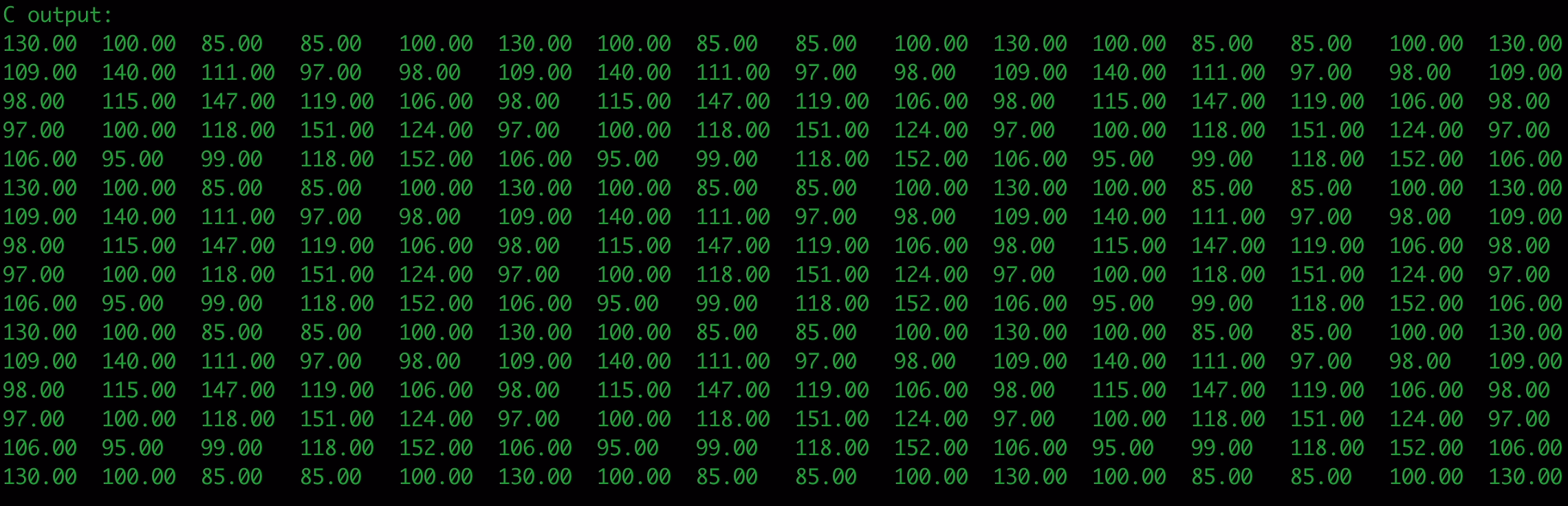
But I found the result using tensor core is wrong compared with the result using pytorch.
Why is that? Is there anything wrong with my code? Thank you!
#include <vector>
#include <stdio.h>
#include <mma.h>
#include <cuda_fp16.h>

using namespace nvcuda;

__global__ void wmma_ker(half *a, half *b, float *c) {
   wmma::fragment<wmma::matrix_a, 16, 16, 16, half, wmma::row_major> a_frag;
   wmma::fragment<wmma::matrix_b, 16, 16, 16, half, wmma::col_major> b_frag;
   wmma::fragment<wmma::accumulator, 16, 16, 16, float> c_frag;
   wmma::fill_fragment(c_frag, 0.0f);
   wmma::load_matrix_sync(a_frag, a, 16);
   wmma::load_matrix_sync(b_frag, b, 16);
   wmma::mma_sync(c_frag, a_frag, b_frag, c_frag);
   wmma::store_matrix_sync(c, c_frag, 16, wmma::mem_row_major);
}

void test_gpu(int m, int n, int k) {
        std::vector<__half> a, b;

        a.resize(m * k);
        b.resize(n * k);

        std::vector<float> c;
        c.resize(m * n, 0);

        printf("A:\n");
        for(int i = 0; i < m * k; i++) {
                a[i] = i % 5;
                printf("%.2f\t", (float)a[i]);
                if((i+1)%n == 0) printf("\n");
        }

        printf("B:\n");
        for(int i = 0; i < n * k; i++) {
                b[i] = i % 5 + i % 4;
                printf("%.2f\t", (float)b[i]);
                if((i+1)%n == 0) printf("\n");
        }

        __half * d_a, *d_b;
        float *d_c;
        cudaMalloc(&d_a, sizeof(__half) * m * k);
        cudaMalloc(&d_b, sizeof(__half) * n * k);
        cudaMalloc(&d_c, sizeof(float) * m * n);

        //transpose(a.data(), m, k);
        //transpose(b.data(), k, n);
        cudaMemcpy(d_a, a.data(), sizeof(__half) * m * k, cudaMemcpyHostToDevice);
        cudaMemcpy(d_b, b.data(), sizeof(__half) * n * k, cudaMemcpyHostToDevice);
        //gemm_cpu(a.data(), b.data(), c.data(), m, n, k);
        wmma_ker<<<1, 32>>>(d_a, d_b, d_c);

        cudaMemcpy(c.data(), d_c, sizeof(float) * m * n, cudaMemcpyDeviceToHost);

        printf("C output:\n");
        for(int i = 0; i < m * n; i++) {
                printf("%.2f\t", (float)c[i]);
                if((i+1)%n == 0) printf("\n");
        }
        printf("\n");
}

int main() {
        test_gpu(16, 16, 16);
        return 0;
}
import torch

a = [i%5 for i in range(0, 16 * 16)]
a = torch.Tensor(a).reshape(-1, 16)

b = [i%5 + i % 4 for i in range(0, 16 * 16)]
b = torch.Tensor(b).reshape(-1, 16)

print(a)
print(b)
print(torch.matmul(a, b))
C++ output
python output
